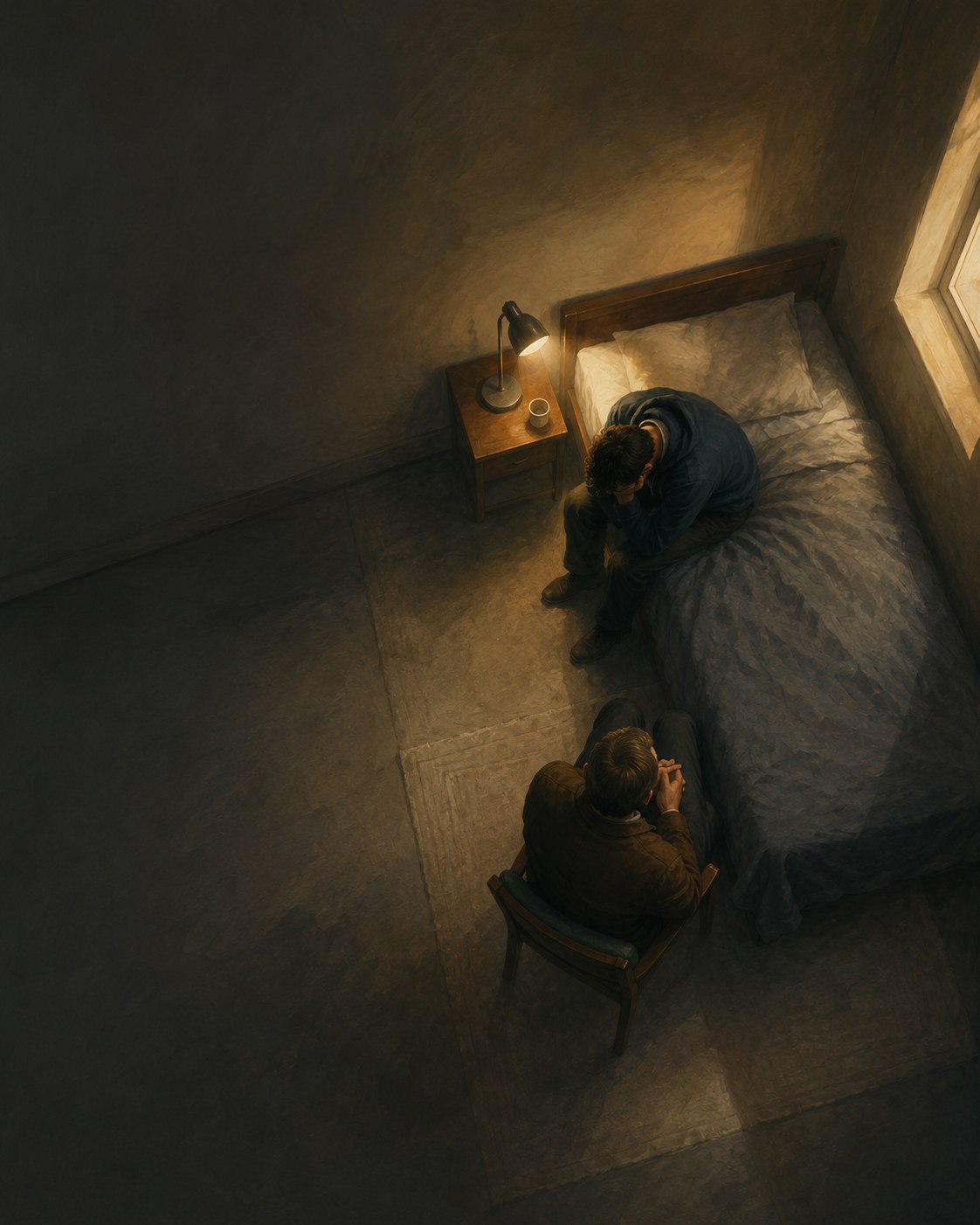

From “What’s Wrong?” to “What Happened?”

In his essay on trauma-informed care, Bob described a shift in perspective: from asking what is the matter with someone to asking what happened to them and how it affects their life now. He wrote as a provider who had spent decades working with children and adolescents.
What is wrong with you?
Asked as an accusation, that question can make a person feel judged before they have been heard. Bob’s alternative invites attention to experience as well as behavior.
He did not describe one miraculous conversation that changed everything. He described learning to see his clients through a new pair of glasses:
What happened to you?
The difference is a willingness to learn something before deciding what a person’s behavior means.
What the Question Does
When what is wrong with you becomes a verdict, it can narrow the conversation to a person’s apparent failings. An assessment may be necessary; an accusation rarely helps someone explain what is happening.
Asking about experience can widen that view. It makes room for circumstances we have not seen, without assuming that a single event explains a whole person.
Bob’s original essay describes children who had experienced abuse, neglect, violence, and instability. He argued that care needed to take those experiences seriously rather than look only at the behavior bringing a child to professional attention.
The invitation also has limits. Someone may not want to recount what happened. A caring response can respect that choice and ask what would help them feel supported now.
The Care Around the Question
Bob situated the question within trauma-informed care. In his essay, relationships, safety, purpose, and the capacity of caregivers matter alongside an understanding of adverse experiences.
That framework should not become a shortcut to diagnosing every difficult behavior. A chaplain may not know a person’s history, health, or present circumstances. Curiosity is useful precisely because that knowledge is incomplete.
The practical point is to leave room for what is not yet understood. Supportive relationships can sit alongside clinical assessment and treatment; a reflective question does not replace them.
The question is an opening, not an explanation or a demand for disclosure. It can be followed by something simpler: What would be helpful right now?
What to Look For
Watch for the moments in your own life when you catch yourself asking the wrong question — of yourself most of all. The internal voice that says what is wrong with me? when you are struggling. That voice is almost always asking the wrong question. The right one is: what happened, and what did I learn from it that I'm still carrying?
When you encounter someone whose behavior confuses or frustrates you — a child acting out, a colleague who seems unreachable, a family member whose choices make no sense — resist the first question. Ask the second one, even if only to yourself. What might have happened to this person that would make this behavior make sense?
You do not have to say it out loud. But the question will change how you see. And how you see will change what you do. And what you do — the patient, curious, non-shaming presence you offer — may be the thing that finally gets through.
Understanding more of a story may change our response. It will not make every action understandable or remove the need for boundaries. It can keep uncertainty from hardening too quickly into a judgment.
Ask with care. Then respect the answer, including a wish not to talk.
— A reflection on the life and work of Robert Kenneth Jones (1950–2020).
Bob Jones spent more than four decades quietly innovating in the treatment of addiction and the wounds of childhood abuse. The Next Right Thing continues his archive of recovery, resilience, and faith.